Monday, September 26, 2016

Myths and truths from the Quran

Chances are that your Facebook or Tweeter feed have been populated with videos about the crazy things Muslims plan to do to overtake the world and subject it to sharia law. Chances are, also, that you sometimes have doubted the veracity of the information, but don´t have the time or interest in snooping it. The news help feed the fear with their reports about the atrocities of Isis and the eminent risks of a terrorist attack. There are also a few voices reassuring that not every muslim hates the west, and that extremists are not good representatives of the faith, but their voices are silenced by the actions of a few. On top of that, there are still lots of myths about Islam and its beliefs. Do they want to establish sharia law wherever they go? Does the Quran mandate to kill all the infidels? Does the Quran allow men to beat women? What about polygamy? Do they really believe that everyone other than Muslims will go to hell? 
Where to start looking for the truth?
In the last 15 years, hundreds of books about Islam have been published. A few have been written to confirm people's fears, but most attempt to offer clarity about the muslim faith. There are also the brave souls that read the Quran on their own in an attempt to sort things out. Carla Power, an American journalist living in England, is one of those looking for the truth. Her first impressions of muslim societies were formed in Egypt, Afghanistan, Iran and India, where she lived as a child; as a seasoned journalist writing about muslim societies for magazines such as Time and Newsweek, she developed a wider understanding of the culture and the religion. However, the events that lead to 9-11 and the consequences of the attacks ignited the need to read firsthand the Quran, thought to be the source of all contention.
'If The Oceans Were Ink' is the memoir she wrote after studying the holy book with a muslim scholar for a year. Muhammad Akram Nadwi, a former colleague at Cambridge, accepted her proposal to study the book that 2 billion people consider holy, and that is also blamed for violent actions against western society.
Powers and the Sheikh, her scholar friend, found in their journey the spirit and the historical context of polemic verses (suras) that excite both fear and rage.
They studied the verse of the sword (9:5) that calls for "killing the idolaters wherever you find them." While jihadists and Islamic opponents find in it the argument for armed confrontation, the Sheikh contends that it was written specifically for the people in the times of the prophet Muhammad. Where some read in it a call for imposing Islamic law, the scholar finds an exhortation for personal piety and submission.
Women wearing hijabs in Malaysia 
In an intense meeting at a coffee shop in Oxford they discussed the women's passage (4:34). It states that men are superior to women, and that they can impose their authority even by force. Instead of contradicting the text, the Sheikh offers specific examples taken from the Prophet’s life on how to read, understand, and live this mandate. On the subject, Power includes a thorough explanation on the history behind the use of burkas, niqabs, hijabs, and veils.
With a detailed and entertaining narrative, Powers included in her memoir details about the lives of the Sheikh's family and other muslims in England. She visited the professor’s hometown and madrasa in India, and even contemplated the idea of going for a pilgrimage to Mecca.
Together they explored the power of culture and tradition in establishing rules and law in different muslim countries, and openly debated traditions such as child marriage and the concept of martyrdom. The account of this unique friendship between a pious muslim and an inquisitive secular is not only entertaining, but informative and revealing about the different shades and currents of Islamic thought.


Wednesday, August 31, 2016

In the land of the robed monks


Monks practice dances for their annual festival in the courtyard of Thikse Monastery. 
Souvenir shop in Leh.


Taking from stories about the Silk Road traders and the trails they crisscrossed for centuries, Rudyard Kipling gave us a glimpse of the Himalayas through an old lama and his faithful Sherpa, Kim, who traversed northern India in search of an auspicious river. In their adventure they met hunters, rich women, English soldiers, spies and horse traders. Kim is a fascinating novel that illustrates life in Northern India in the late 1800s. On March 17, 1959, the Dalai Lama made history when he trekked those same mountains for about two weeks, in order to escape imprisonment by the Chinese government. From Dharamsala, his adopted hometown in the Indian Himalayas, he still advocates for autonomy in the Tibet region. Today, hundreds of hikers, bikers, pilgrims and adventurers go to Ladakh to experience the majesty of the mountain desert, and to get a glimpse of life in the famed land.
Shanti Stupa, a peace pagoda.  
Accessible by airplane since the 1970s, Leh sits as the region’s capital and gateway to all its attractions. Despite the proliferation of hotels, cafes, and tour providers, it continues to charm with its white, flat roofed homes, narrow streets, and local robed women who sell their fresh vegetables at the boulevard. School kids, Nepalese refugees, and construction workers roam the center of town, where the Royal Palace and the central mosque share space with souvenir shops, bazaars, and sweets stores.
Upper Hindus Valley seen from Shanti Stupa. 
But Leh is just one of the many towns that occupy the Upper Indus Valley, a region that glows with fields of mustard, barley, and other vegetables harvested in the summer. A good way to see its scope is to visit Shanti Stupa, a large white dome built by the Japanese atop a rocky hill in 1991. It offers spectacular views of the valley and its surrounding villages.    
A young monk showing temples' keys. 
Long before airplanes and paved roads, the Ladakh region was well known among traders, as it was the halfway point of one of the various silk routes that ran between India and China. In fact, merchants carrying their loads on yaks, camels, mules, and horses have crossed this area for over 8000 years, as it was recently discovered by researchers who found remains of charcoal from ancient bonfires in the same place where workers are building a new road.
It was through these ancient routes that Buddhism got to this part of India. Along with spices and hides, traders brought the teachings of Gautama Buddha. Soon after, robed monks trekked the rugged trails looking for peace and quiet. Some stayed in the Ladakh region, and many others went to Nepal, Tibet and ultimately China, where Buddhism took root and expanded throughout Southeast Asia.
With time, the meditation caves that pious monks inhabited turned into monasteries that grew with the flourishing of the faith and the support of the royal families. The blending of Buddha’s teachings with the animistic beliefs of the inhabitants created a very rich mythology; monks and artists developed unique artistic expressions, and the relative isolation kept the religion almost free of reforms and change. Hundreds of pilgrims and tourists flood the region in the summer months to see this authentic manifestation of the faith.
Monks' robes ready for use in a temple. 
It is actually in villages nearby Leh where impressive Buddhist monasteries have succeeded. The largest, Thikse, is a 12 story structure built in the 15th century that houses a library, a museum, a nunnery, and dwellings for about one hundred monks. It is said that this temple resembles closely Jokhang temple in Lhasa, Tibet, where Dalai lamas lived for centuries. One of its main attractions is a beautiful statue of Maitreya, or the future Buddha, that measures 49 feet and occupies two stories. There is also a Tibetan pharmacy, where a monk takes consultations, and prescribes blessed pills.
Maitreya, or Future Buddha. Thikse Monastery 

Hemis is another village famous for its monastery. This one is dedicated to Guru Rimpoche, a Buddhist master venerated in Northern India. It has a large courtyard where monks celebrate their festival and mask dances in early June, and it holds an impressive collection of Tangkas, a specific form of art composed of a religious painting framed in beautiful silk brocade. Besides learning about the temple’s history that dates back to the eleventh century, visitors can hike up to the golden statue of Maitreya Buddha that overlooks the temple.
The oldest, and most revered of the monasteries in the Indus Valley is Lamayuru. Built in the 16th century in a land that was already considered sacred by Buddhists, it has been the center for religious activity in the area for centuries. In the month of June, monks from all the region gather to witness Yuru, Kab-gya, a festival that celebrates the triumph of good above evil. Visitors and pilgrims get together to enjoy the mask dances, the hypnotizing sound of gongs and cymbals, and the unique ambiance that permeates the place. Mingling with the locals provides an unforgettable experience.  
Children enjoy the festival in Lamayuru Monastery. 

Most of these monasteries are located on or near the famous Manali to Leh road that hundreds of bikers traverse every summer. This road connects also with Khardung La road, the highest drivable pass in the world. Severaltravel agencies have motorcycles for rent in Ladakh, and offer camping tours all over the region. As the tour vans move from one monastery to the other, locals harvest mustard in their parcels, or collect wood for the winter months. The more adventurous travelers bike to the Khardung La pass, go for rides to the sand dunes in the Nubra Valley, or trek from valley to valley camping under the stars. Hikers, bikers, and meditation enthusiasts find in the slopes of the Indian Himalayas the path they came looking for.


View of Thikse Monastery 

Thursday, July 21, 2016

Two words about India

Morning at the Taj Mahal 


I overheard somebody at a restaurant saying that they did not like India at all because it was a dirty country. I could not help it but take it personally. Having been there, I have something more to say other than, yes, some of the places my husband and I visited were dirty.
To say we went to India is to fill our mouths with a big word. India is a subcontinent inhabited by over a billion people, where 64 languages and at least 400 different dialects are spoken. It is divided in 29 states and independent regions with different culture and traditions, and all major religions of the world are represented. It has miles of beaches, deserts, mountains in the Himalaya’s Plateau, rain forests, and 30 cities with at least one million residents. It boasts 21 monuments as World Heritage sites, and some of their archaeological finds date back 7000 years. We saw a speck of India, and it would be simplistic to define it in just one word.
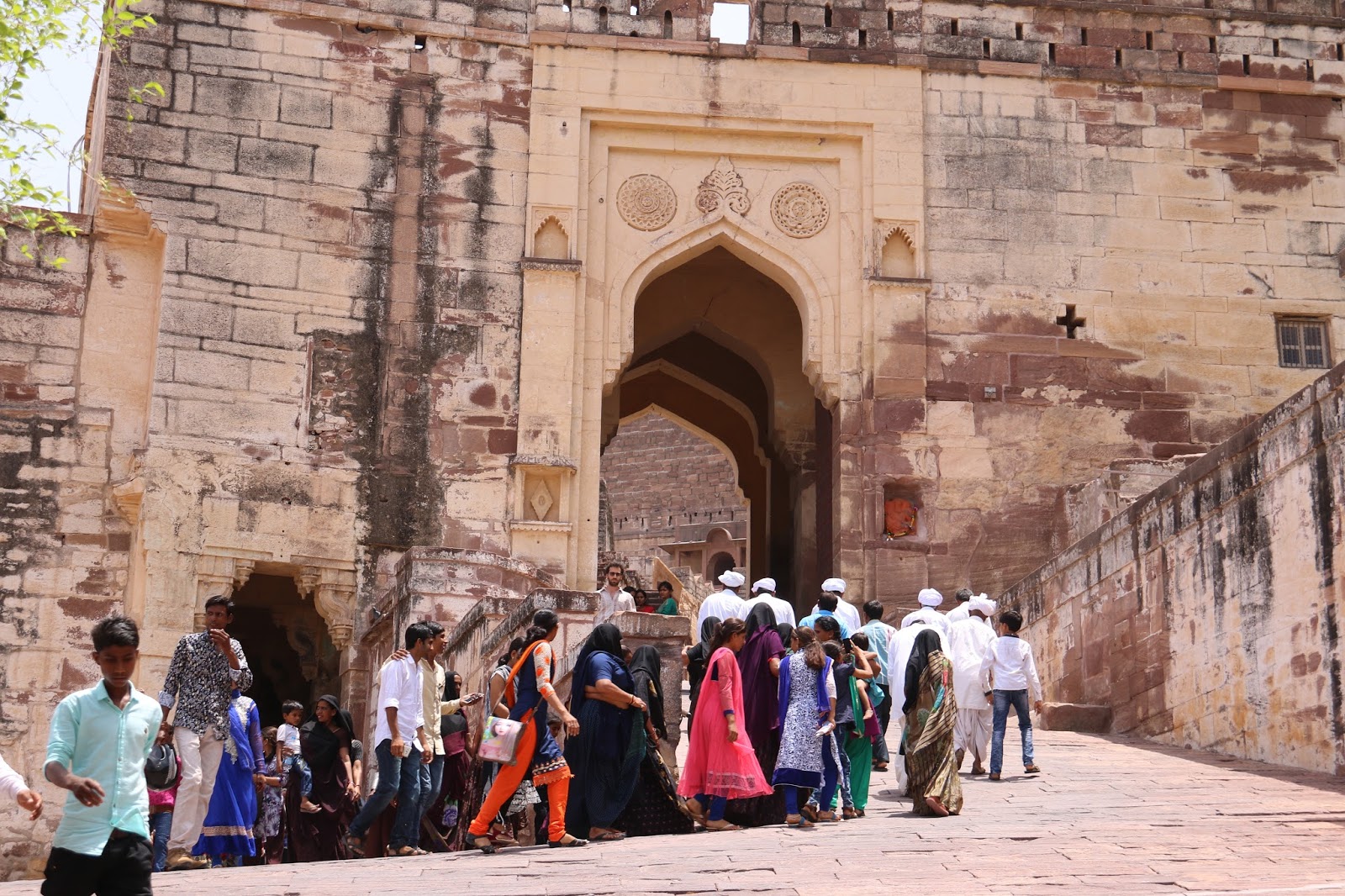
Mehrangarh fort in Jodhpur  
In our journey we did not go to see modern India. We just got a brief glimpse of Central Delhi and its governmental buildings, quiet museums, and wide roundabouts populated by countless rickshaws, buses, and motorcycles. We skipped Mumbai and its sparkling movie sets, ultra-modern real estate projects, its world famous Victoria Rail Station, and of course its slums, that hold about 4 out of its 13 million residents. 
We went to see India’s grandeur through its historical sights. We visited forts built by the maharajahs 450 years ago; we entered the most famous mausoleum in the world, left as a testament of love and splendor; and we contemplated temples of various religions that stand as evidence of a spiritual people.
Entrance to Ranakpur Temple 
As we moved from place to place, either walking, or riding a rickshaw or a tourist car, we got to see India’s daily life: women washing clothes in their doorway, worshipers leaving offerings in the temple, children walking to school with their grandparents, storekeepers measuring grain, drinking tea, or reading the newspaper, and even goat herders finding their way on a busy intersection. In the midst of all that, we saw sacred cows foraging trash bins, stray dogs running in packs, and a wide variety of monkeys grooming their young or catching bananas thrown by the locals. Yes, there is trash in the middle of that, but to us, the beauty of people’s lives prevailed.
City Palace, Udaipur 
From the forts to the temples to the palaces, a word comes to mind. Contrast might be the word that best describes a visit to India. Contrast in the many ways people live their religion, in their adherence to a millennia old cast system, in the food, so thoughtfully prepared, and in the variety of landscapes, that satisfy any curious eye. There is trash, there is corruption, and there are a lot of problems to be solved. But there is also a country with an old soul, where wars have been fought, conquerors have been defeated, and where the presence of the gods reassure its people that life goes on.  


Monday, June 13, 2016

A closer look to prehistoric times in Texas


Models of Dimetrodon and Edaphosaurus sit at the center of  Whiteside Museum's exhibit hall. 
Following the suggestion of a dear friend with whom we travelled to Seymour Texas for her high school reunion, my mom and I stopped at the Whiteside Museum of Natural History last Memorial Weekend.
Unprepared and uninformed, we started the tour of what we thought would be a tiny museum in west Texas. We were so wrong. For about two hours, not only did we learn about the reptiles that roamed that region three hundred million years ago, but we toured the museum’s laboratory, greeted its director, and got to talk with staffers and volunteers that provide the museum’s unique experience.
Jody Dillard showing a bone segment from an Edmontosaurus.
For the first part of our tour, we were guided by Jody Dillard, a volunteer turned expert in the Permian period. She introduced us to Dimetrodon, Edaphosaurus, Seymouria, and Diadectes, the most common reptiles found in the area. As we walked through the exhibits, that include three-dimensional models and fossils, Jody confessed that she enjoys seeing the joy and surprise when kids and adults learn about these predecessors to dinosaurs. The main room also includes models from a T-rex head, and lots of plant and animal fossils found around Seymour.  
Tracy Houpt explained part of the preparation process. 
After visiting the live animal exhibit, or Zoo-seum as they call it, we saw their laboratory, where two people were studying rocks through microscopes, and digging with tiny tools. There, we met Tracy Jon Houpt, a volunteer from Georgia that besides being a passionate digger, helps updating the museum’s social media outlets.
Even though he had just arrived from a digging site, Tracy used his lunch hour to share some of the fossils he has helped uncover, the projects the team is undertaking, and even allowed us to use some of the paleontologists’ tools. Christopher Flis, the museum’s director, has been working with his team in digging out, preparing, and assembling the fossils of George and Mary, a male and female dimetrodon. They have also found skulls and hundreds of bone fragments from edaphosaurus and eryops.    
Unlike most museums, Whiteside keeps the lab open to visitors.
The Whiteside Museum opened two years ago thanks to the vision of a rancher, the passion of a young paleontologist, and the support from the people of Seymour and Baylor County. Paleontologists from around the world have been digging out treasures from the Texas Red Beds for over one hundred years, and the founders felt it was time some of the findings stayed home, in a museum dedicated to them.
Skull of Diplocaulus
For those familiar with prehistorical animals, the exhibits include fossils from the Permian period, in the Paleozoic era. These animals roamed the earth one hundred million years before dinosaurs did, and research is proving that there is still a lot to be discovered about them.


Jack the Eryops and Harold the Dimetrodon are also part of the exhibit. 
The museum includes models from different prehistoric periods. 

Friday, June 5, 2015

A legacy of love

There is a spirit roaming the hallways at Anne Frank Elementary. Not the spirit of the brave Jewish teenage girl that endured years of isolation through writing, but one that inspires a whole community to go above and beyond their duties to be there for the kids.
It is the legacy that Jonnice Legum Berns, the founding principal of the school, leaves behind as she retires after 18 years in her post. "It is my time to leave. The school needs to keep growing and changing, and someone else will take it to the next level", said the Virginia native, who has worked in the Dallas school district for the past 38 years. 
This spirit was born about 50 years ago when, as a young child, Ms. Berns decided to become a teacher. "My sisters still complain about it", laughs Ms. Berns, as she explains that her goal all along has been to love kids and help them build a strong foundation.
With that mindset, the young graduate from Louisiana State University was recruited to work in South Dallas as a first grade teacher. The African American students cherished her and taught her that love sees past skin color.
Later on, she moved to Robert E. Lee Elementary, where she taught for nine years. "One of my fondest memories is the year I started with 40 kindergarteners”, she recollects. The parents had to help, and together, they built a tight community. Berns still communicates with members of that class. “There was a child that created intricate clay figures, and we knew he had an extraordinary talent for the arts”. She has seen the work that he now does as a film illustrator in LA.  
Even though Berns loved the classroom, that same spirit led her to pursue a career in school administration. Part of her education was a Fulbright scholarship that took her to England, where she taught first grade to immigrants from Pakistan and Bangladesh. “It was a great  opportunity to share the values of the American culture with the townspeople, who thought all Americans were like the characters in the soap opera ‘Dallas’”, she recollects. 
Back home, her experiences with different cultures and races served her well. She had to navigate through the subtle barriers of race and gender to become an assistant principal, a position that she held for five years.
In 1997, the district planned to open 6 new schools. Berns went to the groundbreaking ceremony of Anne Frank’s because she had a close connection with the name. Miep Gies, who hid Anne’s family in the annex, came to the ceremony. I knew I had to be there.” Soon, she was selected as a principal and chose to stay there until the end of this school year.
At the corner of Montfort and Celestial Road, that spirit has grown to a culture that respects diversity, honors work ethics, and cares for the whole community. “We take care of the teachers, so they can take care of the kids”, expressed Berns, who is still considering her options after retirement.
This coming fall, the community at the North Dallas Elementary will welcome Ms. Heather Holland, who currently works as assistant principal at L.V. Stockard middle school.

Friday, January 9, 2015

Farewell to the dreadful list

No more resolutions. Amazing!
No New Year resolutions for me in 2015. I already made some last year, and the year before. As I read about it a few days ago, the reason people don’t follow through with resolutions is that most are very hard on themselves when committing to these changes. People tend to set the bar too high and want to be perfect at reaching it. So they fail once and give up. Another tendency is to phrase them in a negative or restrictive form: stop overeating, quit smoking, watch less TV, etc. Instead of resolutions, the author suggested to nourish an attitude of gratitude. Cherish what you have and celebrate your daily accomplishments.
The first week in 2014 I pledged to post a weekly entry in one of my blogs. Just like the article mentioned, it was a lofty resolution, and very soon I got discouraged from following through. Another resolution was to improve my running time. Overall, I painfully lost almost three minutes in my average 5k runs. In hindsight, it looks like stating a goal is a very successful way for me not to accomplish it.
Here is the catch, though. Practicing gratitude solely will not get me where I want to be. There are these lingering dreams that bug me almost every evening; goals that won’t settle to become unmet expectations. In fact, these aspirations have come up every year during ‘resolution’ time. Giving up is not an option. Neither is writing them up again.

Well, for those of us who fancy celebrating a new year, here it is. Brand new —minus the ten days that went away getting ready for it—. I am immensely grateful to witness its arrival, excited to sense its possibilities, and challenged to take what it has to offer. There is not a resolution list, but there is a renewed commitment with my old goals. Today I celebrate my daily accomplishment, and rest assured that “tomorrow will worry about itself.”

Friday, November 7, 2014

An unlikely gratitude list


In November, as leaves fall and pumpkins rest in porches and front yards, gratitude lists pop up in school hallways, Pinterest boards, and neighborhood magazines. People are grateful for families, jobs, and good health. Not many, though, include pain and disease in their list.
Austin Pruitt is one of the few who do. At 24, he has experienced almost five years of constant pain. Intracranial Hypertension causes him severe, chronic headaches that prevent him from living a normal life. However, he credits this rare illness as the key that unlocked his outpouring of gratitude. “From the early days of the disease, I started noticing that lots of people loved me. Being in pain allowed me also to realize that everyone hurts in one way or another. Because I have experienced physical and emotional pain, I can truly sympathize,” he explained one afternoon not long ago.
From his home in Dallas, Mr. Pruitt grew up planning to follow his father’s footsteps. He enrolled in college at 18, and was counting on going to medical school. It was studying at Harding University, during his freshman year, when he started to experience severe headaches. Soon, the pain became so strong, that he could not go on. One strong episode marked the first of several visits to the Emergency Room. In 2009, Pruitt traded his life in college for a full time cycle between emergency rooms, doctors’ offices, and recovery units. That was also the beginning of his journey towards thankfulness.
“I am grateful because I am not alone”, he expressed. His father, a plastic surgeon, is committed to finding a cure to this rare disease. Together, they have researched and visited lots of specialists around the country to discuss treatment options. Mr. Pruitt credited his family with providing the love, strength, and faith he has needed to go on.
Pruitt also appreciates the opportunity to share his experience and hope with thousands who have the same condition around the world. Besides participating in online support groups, he started his own YouTube channel. It includes original piano compositions, as well as chats about spreading joy, loving unconditionally, and living stress free. “This condition has given me the opportunity to think about topics greater than myself”, he expressed.
Last October, Pruitt delivered a sermon at his home church about the difference between pain and suffering. “Those who suffer from chronic pain can tell exactly what level of discomfort they feel at any given time. It is a fact. It is there. Suffering, on the other hand, is the feeling attached to the pain,” he indicated. “I cannot control the pain, but I can choose to either grumble, or shift my focus.”
His strategy for coping with constant pain is living in the moment: “It takes away the weariness of yesterday’s pain, and the fear of tomorrow’s. I found that playing the piano takes away the urgency of concentrating on the pain,” he stated.
For Mr. Pruitt, a daily gratitude list is also an effective antidote to both physical and emotional pain. “Even during the worst days of my pain, I have joy. I know that God has a plan, and that Intracranial Hypertension is not all there is” hinted Pruitt with a wink.
As he admitted that living in pain has aged him prematurely, he noted that his priorities have changed. That is why he advocates living with the less fortunate in mind, soothing hurting hearts, and pursuing a meaningful life. “This condition took away my career, but gave me the opportunity to tutor, teach piano, and even to write a book”.   
Drawing from his love for baseball, which he played throughout high school, Mr. Pruitt suggested that one decides whether or not to hit the balls that life throws. “Some try to hit a homerun with every opportunity, while others stay still, waiting that circumstances decide their game. This is the ball I got. It is a difficult one, but I will swing at it the best I can. So far, this disease has allowed me to take my music seriously, compose, and even give piano lessons,” explained Mr. Pruitt.
Not surprisingly, Mr. Pruitt conceded that Intracranial Hypertension has brought yet another gift to his life. While sharing his strength with groups of people, he discovered that he enjoys public speaking. I might be good at it too!” he concluded with a wide smile.    

Friday, October 10, 2014

The purpose of a journey

It takes courage to wake up every day and go to a job that does not fit the one you had dreamed. It takes maturity to understand that a job pays for living expenses, and that not everyone is lucky enough to do what they love and get paid for doing it. As the saying goes, work sucks, and that is why you get paid to do it.
It seems like many of us live in that reality. It takes a daily resolution to try and do one's job as good as possible. The natural thing to do is complain and wish for a better opportunity; the harder one is to persevere and appreciate all the advantages that come with employment.
Government data from 2013 revealed that just by having a career, one belongs to a privileged group of people. In the United States alone, 33% of the population have a college degree, a number that increased sharply from the late nineties, when 24% of the population obtained a diploma. In other parts of the world these numbers shrink radically.  
While it is easy to spend time comparing our careers to those of more notorious college peers, it takes a little more effort to see the perils of others, who with degrees or without them have had to deal with much more than an unfulfilling job.
Last week I met one of such people. His name is Austin. He is a good looking twenty-something who should be enjoying college and getting ready for a successful career in medicine. Instead, for the last three years, he has battled headaches so severe that caused him to drop out of school. After 18 surgeries, lots of prayer, and a precocious maturity caused by pain, Austin has learned to see God’s purpose for his life. He might not be able to read an anatomy book because his eyes hurt constantly, but he can understand people’s pain and suffering.
Another great warrior is my aunt Olga Lucía. For the last two years, she has been balancing on a thin line between life and death. After beating all odds, she survived a sepsis, and at least 10 surgeries to restore her colon functionality. Through her disease, though, the family has gotten closer to each other and, most importantly, to a God who heals, strengthens, and comforts.

Everyone is fighting a battle. Yours might be against disease, laziness, or world values… or, why not, against a job that does not fulfill. Looking at other’s suffering won’t solve our problems. It might, however, cause us to be more empathetic, to look at the positive side of things, and to think more realistically about the ultimate purpose of our journey.  

Sunday, August 31, 2014

Sightseeing from the heart

We followed these African ladies just to hear them chat.
Summer memories are the sweetest. For my mom, though, memories about the people she met on vacation are the best. She is a curious person, and an observant one too. She takes lessons from cities' laws and customs, from restaurant menus and decoration, but mostly, from people's actions and behavior. 
For a few years, she has wanted to go to the east coast. Even though she could have gone on her own, she waited until an opportunity opened up so we could go together.
This was a busy summer for both of us. She spent over a month visiting her children and grandchildren; I had a memorable trip with my husband overseas. A week before starting school, though, she offered me an airplane ticket and convinced me to visit Washington D.C. and New York with her.
As we sat at the airport's waiting room, I chuckled to notice that a kindle, a cellphone or a magazine were of no use to her. She wanted to spend her time looking at the by passers: parents going on vacation with their children, couples quarreling over little things, and businessmen ignoring everything that goes around them. When I suggested to stop looking because she may appear nosy, she clarified that she was just witnessing what happened in front of her.
We bookedrental properties instead of hotel rooms, so we stayed in residential neighborhoods and took public transportation to see the sights. After all, sights are secondary to her. She wants to see how the locals live; to feel the city's heartbeat, to hear its rhythm. The commute, then, is part of the sightseeing.
Visitors at Arlington Cemetery
In DC, we were 45 minutes away from the Washington Mall. Every morning, as our bus filled up with students and office workers, she noticed their interaction with the bus driver and other passengers. From her window seat, she spotted popular breakfast places and pointed out possible dinner choices. She also identified additional bus routes to navigate the neighborhoods. 
While visiting the monuments around the mall, my mom's ears were tuned to people's accents and languages. We found ourselves following groups of African women and Chinese teens in order to hear their chatting. 
A tourist filled Lincoln Memorial
In two places, however, she closed her eyes and listened inside. At the Lincoln Memorial, memories of her father, a studious fan of Lincoln's life, came to mind. As we walked around Arlington’s Cemetery she grieved, not only for all the lives lost during the wars, but also for the many loved ones she has lost.
The Spanish speaking Lebanese 
Her favorite memory of DC, however, came from Union Station’s parking lot. As we waited for our New York bound bus, a Lebanese man in a green and orange vest shared with us, in fluent Spanish, the highlights of his life. As he checked the passenger’s tickets, he talked to us about the rise and fall of his businesses, his journey to America, and even the loss of his precious son. We waved goodbye after singing along a few songs from the Mexican singer Emmanuel.

In the heart of the Big Apple

We knew that our rental inNew York City was not precisely convenient for sightseeing. We were ready for our daily 45 minute subway ride to Manhattan. We chose it, though, because this particular place has excellent reviews form previous visitors, and because the neighborhood seemed safe and convenient. What we did not know was that we were in for the greatest treat of our trip: without expecting it, we found our home away from home.
Our home away from home
Visiting the Statue of Liberty was inspiring; walking through Central Park, relaxing; strolling in Broadway, dazzling. Getting home each night, however, was the best part of our visit to New York.
Reading time
The hosts, Miriam and her son Alex, were usually home. Despite her long days at work, Miriam prepared a drink for us every evening, and even bought pastries to share. We sat in their kitchen table and talked about our families, our country, and our lives in the States. For a 19 year old, Alex was an excellent host. He shared his street smart tips, quietly listened to our conversation, and graciously took our advice for improving his bilingual skills. We missed Gildardo, the household head. He works night shifts, but is the one who makes sure the rental is as clean as any room at the Four Seasons hotel.
This time I followed suit. Instead of planning our next day’s itinerary, I leaned on the locals’ advice; my book stayed closed, and my cellphone was turned off. I also started sightseeing from the heart: enjoying conversations with strangers, learning from the behavior of the commuters, and looking for the rhythm of a city that emanates life.

Summer sunset at Coney Island. 


Sunday, June 1, 2014

An epic fundraiser

Students made posters announcing their pledges to the Leukemia and Lymphoma Society. 
After what I will call an epic fundraiser, my students and I are getting ready to enjoy a pasta dish at a popular food chain. Out from their own pockets, 23 children collected about 300 dollars for the Leukemia and Lymphoma society. How did we accomplish the task? It was part day dreaming, part personal conviction.
During a school wide presentation, a representative from the Leukemia and Lymphoma Society gave a brief explanation about cancer cells and gave away piggy banks to collect money for a few days. Teachers would gather the money and submit it. As a reward, the class that accumulated the most funds would be given a meal at a restaurant. Easy enough.
In my case, however, it became an opportunity to teach the kids a few lessons.
My brother Juan Jose and his children
My brother Juan Jose is a cancer survivor. He was diagnosed with non-Hodgkin lymphoma three years ago. It was a time of trial for all of us. Thankfully, after a year of treatment and a lot of prayers, he is healed. Also, two of my aunts have died from leukemia related diseases.
Aurora, one of my 23 students, had a cancerous tumor in her right hand. She had surgery to remove the mass, and she also had bone implanted between her thumb and her index fingers. We prayed over her as a class, and she is now recovering successfully.
Aurora, after the surgery
As the students assembled their piggy banks, I told them about my brother, and explained again that the funds would go to help children like our own Aurora.
—On top of that—I said, if we collect enough money, we might eat pasta in a nice restaurant.
The kids went crazy. Half of them rarely go to a place that does not offer fast food, and a few hardly ever eat out at all. They wanted to know if they could dress up, if we would take the school bus, if their parents would go with them… they even asked if they could order pasta Alfredo!
—We first have to collect the money— I reminded them.
The next day they came to school with full piggy banks: 25 dollars in quarters, 16 dollars in pennies, nickels, and dimes, lots of boxes with 5 and 6 dollar amounts. It was all well. We still had the weekend to collect, and some kids were promising big amounts here and there.
After Memorial Day weekend, the kids came back with surprising boxes: 30 dollars from parents’ and grandparents’ donations; 45 dollars collected at dad’s restaurant; 10 dollars from a lemonade stand, 16 dollars from grandpa’s old coin jar… some children added to their original donation and one, whose mother is a widow with 5 children to take care for, brought a few coins she had saved over the last months.
As the students counted and added their bills and coins, I saw their self-esteem rising, their pride mounting, and satisfaction shining on their faces. We discussed, again and again, the possibility of not winning. They seemed to understand that, in any case, it was a worthwhile cause.   
From the beginning I felt compelled to donate. I told the class that I would bring my coins too, but did not pledge a specific amount. When everything was added up, I opened my wallet and matched the highest individual donation.
We had collected 345 dollars! We were all aghast. I had never experienced generosity of this kind. To make it memorable, we weighed the money, created word problems, and practiced multiplication facts using the coins. We had learned lots of nice lessons out of this fundraising event!
Still humbled, I got to school early the next day. Hopefully, they would announce the winners and all the frenzy would come to an end. However, as I opened my email account, a possibility that had not even crossed my mind became a reality: one of the highest donors in the class took money for the fundraising without mom’s permission. It was my turn to learn a lesson. I apologized to the mother for not being more inquisitive about the amount, I had to talk to the whole class about it, and we had to return a significant chunk of the money that would probably have made us winners.
I decided to have a private conversation with the student. Then, the whole class had a lecture about honesty. Nobody knew who the delinquent was, nor the amount that was to be returned. We waited patiently until an announcement was made.
In time we learned that not only did we win the fundraiser, but we provided almost half of the school’s total collection. We would go to the dinner after all!
I don't know what lessons these students will take with them for the rest of their lives. Maybe some will continue to be generous. Hopefully some will learn not to steal from mom, even if it is for a worthwhile cause. They all learned that teamwork is a powerful thing, even when not all of them participate (not all the students came back with piggy banks).
I definitely learned that children are easily influenced —even gullible— and that a teacher’s word can be taken to heart for a lifetime… but most importantly, that the classroom is a place for learning a lot more than academic standards. 

Adding with regrouping had never been as fun as when the kids were adding the money for the fundraising. 

Sunday, April 20, 2014

A colorful ribbon of highway

Winding Stair Mountain, Ouachita National Forest.  
There is an equal feeling of awe and sadness when visiting Ouachita National Forest in Arkansas and Oklahoma.
Awe, because coming from North Texas it is extraordinary to encounter such an immense mountainous territory covered by pine, white oak, cedar, elm, and cherry trees. Is in this region where the eastern forests meet the endless prairies of the American Midwest.
Sadness, because the most common sight on the highways around this sea of green are gigantic trucks carrying hundreds of tree logs to nearby mills. The feeling, though, quickly turns into quiet meditation when considering the hundreds of wood and wood pulp items used in daily life, most notably toilet paper! It is also encouraging to learn that there has been a sustainable wood production in the area since the 1960s.
It was not always like this, though. During the early 1900s, millions after millions of trees were cut, not only to build miles of railroad, but to feed the hungry mills that popped up in the region shortly after the end of the Civil War. Today, the National Forest keeps a booming business that produces around 27 million cubic feet of wood every year. In fact, their ecosystem management includes wildlife restoration, the effects of human interaction, and recreation opportunities.  
Talimena Scenic Byway
The forest, that covers almost 2 million acres of land in central Arkansas and Southeast Oklahoma, sits atop Ouachita Mountain range, the only horizontal mountain range in the continent. An easy and quick way to appreciate its majesty is through a scenic drive. The Talimena Scenic byway is a 54 mile sinuous road that includes historic sites, trailheads, an arboretum, a resort, and a variety of mesmerizing vistas.
Starting in Talihina, Oklahoma, the roads ascends to a series of rounded, colorful mountains called Winding Stair. In the Spring and Fall months, backpackers and campers abund. They drop off around here to hike Horsethief Springs Trail, once used by real thieves who smuggled wild horses from Oklahoma into Texas.
As the road ascends, the wind becomes a main character in the history of this unique landscape. Majestic miniature white oaks, yellow buckeyes, and short-leaf pines cover the soil on the mountain ridge. Constant wind and extreme soil conditions deny these trees the possibility to grow more than 7 feet tall. The result is a surreal landscape of dwarfed trees where the wind blows hard and the water slips down to feed the trees at the mountain base.
Driving east, past Arkansas' state line, Queen Wilhelmina's resort offers yet another surprise. Built in the early 20th century by Dutch investors, this european style resort delighted railroad travelers for a few years, but it quickly proved financially unsuccessful. After years of neglect, it was restored in the
1980s, and it is again being renewed to host outdoors lovers and bikers alike. A few miles forward, a fire tower signals the highest point of the drive. An old picture of the fireman's family, some picnic tables and a mighty wind bid a quick farewell to visitors. The road, then, descends towards a few more spectacular vistas of the ridge and the communities around.
Luckily for the neighbors, there is still a veil of mystery around it. Most visitors are outdoor enthusiasts from Oklahoma, Texas, and Arkansas. During the fall, however, the highway becomes a pilgrimage for photography enthusiasts and landscape lovers. The beauty that Ouachita National Forest offers through its hiking trails, campsites, and water reservoirs is a gem waiting to be found.

Monday, March 3, 2014

Vastness, wilderness, and silence converge in Big Bend National Park

“Wild country, completely untamed by man, but a good place to come to get your problems in perspective.” Lady Bird Johnson.


Used as we are to the commodities of the United States Highway System, my mom and I drove to Big Bend National Park without much thought. “It is lonely out there. Make sure you have extra gas and blankets” a close friend warned us before we left San Antonio. Winking at each other, we thanked her and went away.
Agave, also called Century plant. 
We had been to west Texas before. We had studied the map (or so we thought!) We knew that we would find a gas station and a hotel in any town along the road, as we had always experienced. Highway 10 lead us west to Kerrville, Junction, Ozona, and Fort Stockton. Yes, it was lonely. Yes, it was a long road. But as we had predicted, the town had its share of hotels and motels. Since it was early in the evening, we ditched motel row in Fort Stockton and headed south, to Marathon.
Weathering and erosion carved the park's mountains. 
Road 385 showed us a new shade of solitude. We did not see a car, a truck or a motorcycle during the whole drive. It seemed unusual, since the estimated 300.00 visitors to Big Bend start arriving in November. Their busy season, we had read, runs from Thanksgiving through April.
Although the sunset greeted us with warm hues of orange, pink and purple, the threat of darkness was looming in the air. Luckily, as the sun disappeared, the first houses of Marathon popped up.
Loneliness was then a thing from the past. People gathered around the historic Gage Hotel; motorcycles roamed the main road, and the smell of grilled food filled the night. Even though Marathon’s population does not exceed 500, visitors seemed to make up for all the activity around.  
Cactus and the Mule's Ears Mountains.  
This exciting scene, however, was not for us. We could not find a room in town. We then headed west, towards Alpine, where plenty of nice rooms awaited hikers, hunters, and workers alike.
In the vastness of the Texas landscape, the sun shone early. We drove the empty road towards the park entrance on the west, and after a quick glance to the map, took the road to Santa Elena Canyon. The landscape welcomed us with its desert vegetation and eroded mountains resembling effigies, ruined castles, or mule ears. The end of the road is the beginning of Santa Elena trail, a rewarding moderate hike that reminded us of the power of water and time.
The end of Santa Elena Canyon trail. 
As a whisper, the canyon walls reminded us also that a whole different country lies behind them. For centuries, Mexican vaqueros and early American settlers made a living there. Farmers, hunters, and cattlemen were the lords of the land before 1944, when the territory became a National Park.
As the sunset light shone against the Chisos Mountains, we headed to the lodge. On the road, a javelina, a roadrunner, a skunk and a coyote showed up. We missed, though, the wild donkeys that sometimes roam from one frontier to the other through the park.  
After dinner, the Milky Way guided our thoughts as we sat quietly in the balcony of our room.

We woke up early, eager to hike Window Trail. However, the possibility of running into mountain lions or bears deterred us from completing the mission. Going downhill, the solitude, the sound of cracking leaves nearby, and our lack of experience convinced us to change our plans. We had heard enough of mountain lion and bear attacks. The Chisos basin loop trail looked like a rewarding, yet safe alternative to being in the wild. The expanse visible through the many views on the trail explained the solitude we felt, despite the fact that the lodge was full.

We left Big Bend longing to see more of the intriguing weathered mountains, the wilderness of the desert and the abundant life around the Rio Grande.